Why Your Quality Management System Must Live Every Day

A well-designed Quality Management System is a good thing. A QMS that lives, breathes and guides teams every day, that is what truly makes the difference. In many organisations, the QMS remains too often locked away in thick documents, consulted only during audits. This reality deserves to be questioned, with care, but with clarity.
A QMS: Far More Than a Certification Document
The ISO 9001 standard, whose new version is expected in autumn 2026, is built on a fundamental principle: continuous improvement. This principle is not a box to tick, it is an organisational posture.
📊 Over one million active certificates worldwide, ISO Survey 2024
ISO 9001:2015 insists precisely on the risk-based approach, leadership commitment and continuous improvement as living practices, not as formal obligations. Whether an industrial SME, a service provider, a public institution or a training organisation, this principle applies universally.
The Pillars of a Living QMS
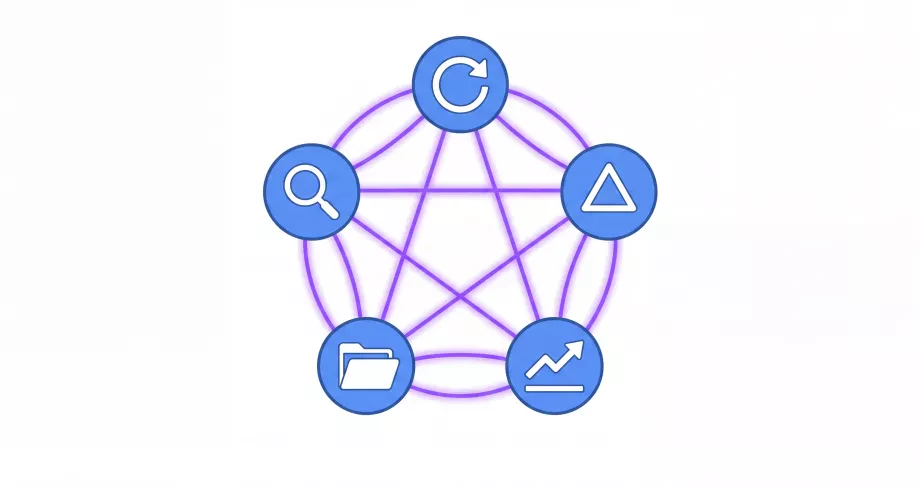
Making a QMS live every day means relying on five concrete and interconnected pillars:
1. Process Mapping and Monitoring
Processes describe how work actually gets done, and how it can be improved. Whatever the organisation's activity, process owners must be able to consult, update and share them without administrative friction.
2. Proactive Risk Management
ISO 9001:2015 introduced risk-based thinking as a central requirement. Identifying risks early, prioritising them and treating them, this is an approach that protects any organisation, from industry to services to the social sector.
3. Improvement Tracking
Every non-conformity, every piece of feedback, every improvement idea deserves to be recorded, assigned and followed up. Without traceability, continuous improvement remains wishful thinking. With it, it becomes a measurable reality.
4. Controlled Document Management
Quality documents, procedures, instructions, forms, must be accessible, up to date and versioned. Rigorous document management is the backbone of any serious QMS, regardless of the sector.
5. Regular Internal Audits
An internal audit is not a control: it is a moment of collective learning. Planned regularly and conducted methodically, they allow the effectiveness of the QMS to be verified and new improvement opportunities to be identified.

A Living QMS Across All Sectors
Quality is not the preserve of any particular sector. It is cross-cutting: it touches operational processes, competence management, stakeholder satisfaction and regulatory compliance.
📊 87% of organisations worldwide are aware that they have or will soon have a skills gap, McKinsey Global Survey
Whether an industrial company, a service provider, a public institution, a training organisation or a social structure, quality managers face the same challenge: documenting complex practices, maintaining sufficient traceability for audits, and engaging teams in a lasting quality culture.
Towards an Integrated and Intelligent QMS
The ISO 9001:2026 revision, currently being finalised, further strengthens the requirement to integrate the QMS into real-world practices. It introduces reinforced guidance on organisational context and knowledge management, two dimensions relevant to any organisation, regardless of sector.
It also accentuates the integration of risks and opportunities in the QMS review: it is no longer simply about identifying threats, but about actively managing improvement opportunities as a strategic lever in their own right. This evolution invites organisations to treat risks and opportunities symmetrically, in a logic of continuous management rather than reactive response.
This dynamic also concerns training organisations certified under eduQua, the Swiss quality standard for continuing education institutions. While eduQua and ISO 9001 address specific requirements, they share the same underlying logic: documenting practices, tracing improvements and demonstrating a coherent, living quality approach. EduQua-certified organisations therefore have every reason to rely on tools that support this continuity, well beyond audit deadlines.
📊 Publication expected in autumn 2026, ISO/TC 176 SC 2
Organisations that wish to make their QMS live every day have every interest in relying on a digital ecosystem designed for exactly that: an environment where processes, risks, improvements, documents and internal audits are interconnected, accessible and traceable in real time.
This is precisely the approach of Uscope, the Swiss ecosystem developed by Uchronic SA in Geneva, certified ISO 9001 and ISO 14001. Its Quality modules allow quality managers to steer their QMS every day, from any device. AI-powered assistance is included, activatable or not, according to each organisation's needs.
Hosted 100% in Switzerland, GDPR/LPD compliant, Uscope is designed for any organisation that takes its quality approach seriously.
Sources:
ISO Survey 2024
ISO 9001:2015 & ISO/TC 176 SC 2
McKinsey Global Survey
Gallup, State of the Global Workplace, 2026